VoIP vs. Landlines: Why Your Small Business Needs to Switch in 2026
3. The Best Business Phone Systems for 2026
Choosing the right phone system for your small business is time consuming - especially in these tough times. business.com looked at dozens of options to come up with the following recommendations.
VoIP vs. traditional phone systems for business
VoIP refers to a cloud-based phone system for small businesses that uses a broadband internet connection to make calls. By contrast, traditional phone systems require a physical connection to a telephone network, which needs switches to transmit analog audio to other phones worldwide.
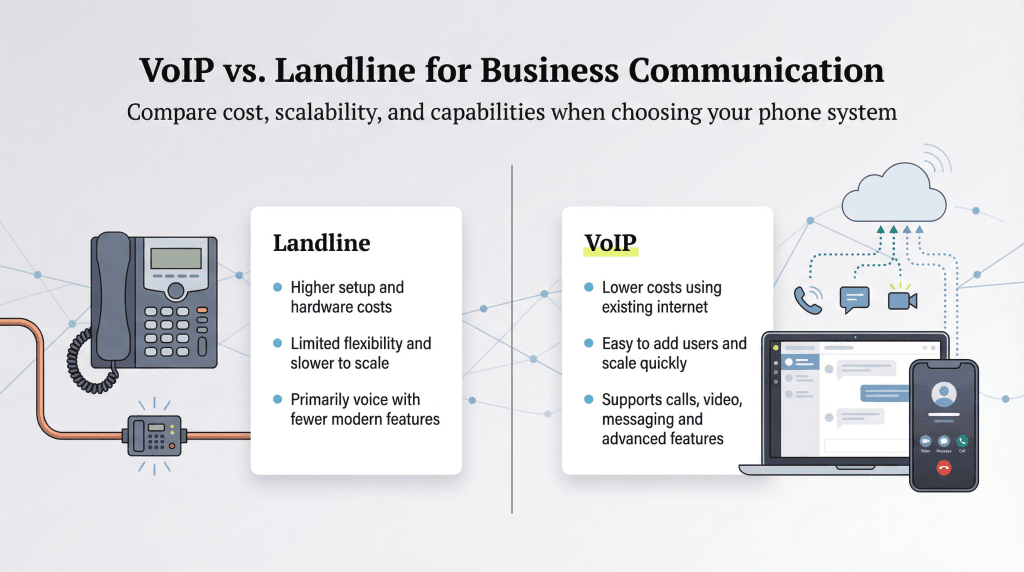
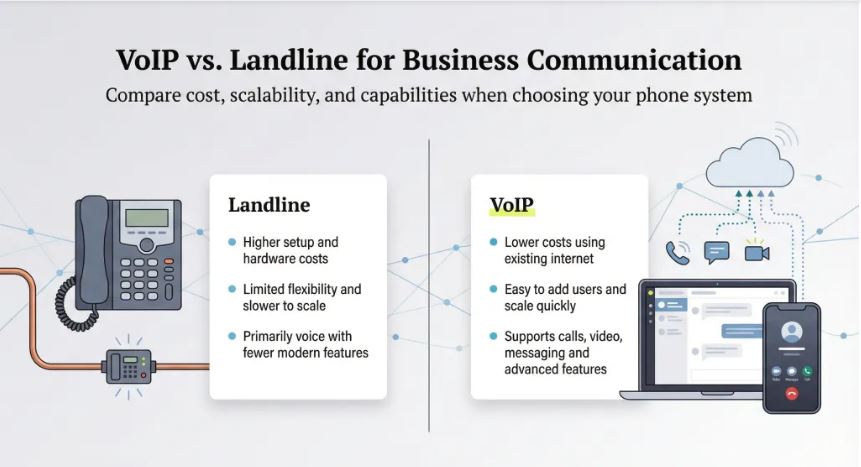
When comparing VoIP vs. traditional phone systems, consider cost, scalability, reliability and capabilities:
- Cost: Because VoIP relies on your existing internet connection, you don’t need to buy additional hardware, like handsets or a private branch exchange (PBX) system.
- Scalability: With VoIP, you can add a new number to your corporate plan in just a few clicks. It’s much more complicated with landlines. A technician must physically attach a new connection to the network, which can be costly. Physical lines also need regular maintenance to ensure nothing is eroding and everything is running exactly as it should.
- Reliability: VoIP is only as reliable as your internet connection, so it is subject to lag, distortion and downtime. Traditional phone systems are more resilient, making them a good choice for redundancy in systems where communications uptime is vital. For businesses that have generally reliable internet connection, though, VoIP systems will probably do just fine.
- Capabilities: A VoIP phone line is much better equipped to handle different forms of communication, like text messages and video conferencing. It also offers access to features such as call recording and archiving. However, if there’s ever a power or internet outage, you’ll lose your ability to communicate with the outside world.
VoIP-powered cloud-based phone systems for small businesses became the go-to choice for a reason, but that doesn’t mean it’s suitable for every organization. Here are its pros and cons.
|
Pros |
Cons |
|---|---|
|
Lower cost |
Dependence on a broadband connection |
|
Comprehensive features |
Limited emergency services |
|
Portability and scalability |
Audio and latency issues |
VoIP pros
- Lower cost: Because they’re compatible with multiple devices, VoIP phone lines tend to have a lower total cost of ownership than landlines do. An employee is usually assigned a corporate computer so they can easily access a dedicated VoIP phone line without needing extra hardware. VoIP phone lines start at just $10 per user per month, making it easy to add lines as your business expands and your workforce grows.
- Rich functionality: VoIP lines can send text messages, images, videos and faxes. They often also provide access to professional business phone system features such as caller ID, conference calling and video conferencing. A VoIP number can easily forward calls to remote teams or employees working from home so you can provide constant support for your customers.
- Portability: VoIP phone lines are completely independent of specific devices or locations. You can tether your VoIP number to a mobile device or laptop to receive calls from clients and colleagues wherever you go.
- Scalability: Cloud-based VoIP platforms are easily scalable for teams and growing businesses. In fact, they are designed to be multiline phone systems, so it’s easy for users to add or delete new lines within seconds without contacting a service provider. Once a new VoIP line is created, a new team member can make and receive calls on PCs and cellphones, so you don’t have to purchase extra equipment. [Learn more about cloud PBX and other cloud-based phone systems]
- Ideal solution for global teams: Thanks to its flexibility and scalability, VoIP is an ideal solution for remote teams. You can create VoIP phone lines for specific regions or countries to provide local support without long-distance charges. Additionally, your business can leverage advanced features like automatic call distribution and intelligent routing to ensure customers reach the right department regardless of time zones.
2.What are the pros and cons of VoIP?
VoIP cons
- Dependence on broadband connection: VoIP’s biggest drawback is its reliance on a stable broadband internet connection. A VoIP phone line transmits data packets through a broadband connection to another line. Without a consistent connection, you could lose audio quality or drop a call entirely. In an internet or power service outage, a VoIP line won’t work.
- Limited emergency services: When someone places a 911 call, emergency service providers track the phone number to find a home address or GPS location so they can send help. This is a problem with VoIP numbers. Because a VoIP phone line appears as an IP address, it’s challenging for emergency services to pinpoint someone’s physical location. A delay can be catastrophic in a situation where every second counts.
- Audio and latency issues: If there’s a bandwidth or latency issue, like an unstable connection or multiple simultaneous users on a single network, problems could ensue. Without the proper connection, the call quality on a VoIP line could suffer, resulting in stuttering audio or lags in teleconferences.
1.What are the pros and cons of landlines?
Landline pros
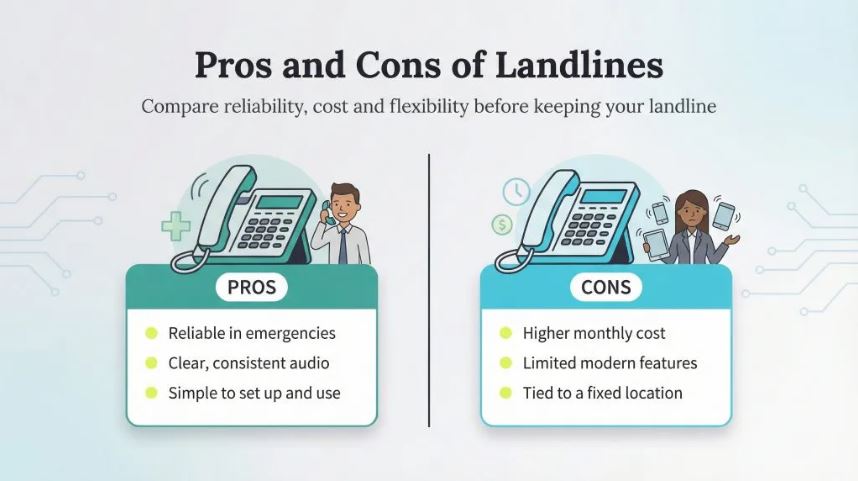
- Reliability in emergencies: Traditional landlines run on their own source of power, independent of the power that connects to a home or an office. If the electricity goes out in your neighborhood, you can still dial 911 and connect to an operator. Because a landline is tied to a physical location and device, emergency services can quickly and easily locate an address and send help.
- Good audio quality: A land-based phone line uses a tried-and-tested network of physical copper lines that deliver consistent voice quality. With a landline’s dedicated connection, you’ll experience fewer dropped calls, and every call you make will deliver clean, clear audio.
- Ease of use: Traditional phone line hardware is easy to learn and use. These devices usually have a handset or a receiver and a keypad. All you have to do is enter the correct number and your call will go through. Landlines are usually stationary within a business or home (unless you have a wireless receiver), so they’re easy to access when someone calls.
Landline cons
- Higher cost: As you’ve likely experienced, traditional landlines cost more, and the more numbers you add, the more that cost increases. For example, if you have a business with 100 people and pay $25 per month for each number, you’re looking at $2,500 per month.
- Limited functionality: A landline is best for audio calls. Because they were created before text messaging, video conferencing or image sharing, traditional phone lines cannot perform many of the tasks that VoIP can. Your growing business may now be at a point where it needs those features.
- Stationary devices: When someone calls your landline number, they’re not calling you; they’re calling your desk or whatever surface your phone is mounted on. If you’re away from your desk, you miss the call if you don’t have voicemail. You could miss a sale or an important call.
How to choose between a VoIP service and a landline?
There are a few important questions you should ask when you’re deciding whether to switch from a landline phone system to a VoIP service.
- How big is your team? VoIP may be the right choice if you now have a large team that works remotely or employees who are scattered across different regions. Because of VoIP’s inherent scaling and portability, it’s an ideal, reasonably priced option for teams that don’t work in the same location. On the other hand, if you still have a small, local team that needs just a few no-frills phone lines, a landline phone service may still be the best route.
- What are your equipment concerns? Consider VoIP if you want to avoid the extra costs of buying a new phone for each new employee you hire. However, if you account for the cost of hardware you already have or will need, a landline option may still be within your budget.
- Which features do you need? A landline is still a good option if you only need to make short local calls. However, VoIP is far more suitable if you want to transfer files from the field, send videos to employees or colleagues, hold video conferences with an entire workforce or leverage AI-powered features like call transcription and sentiment analysis.